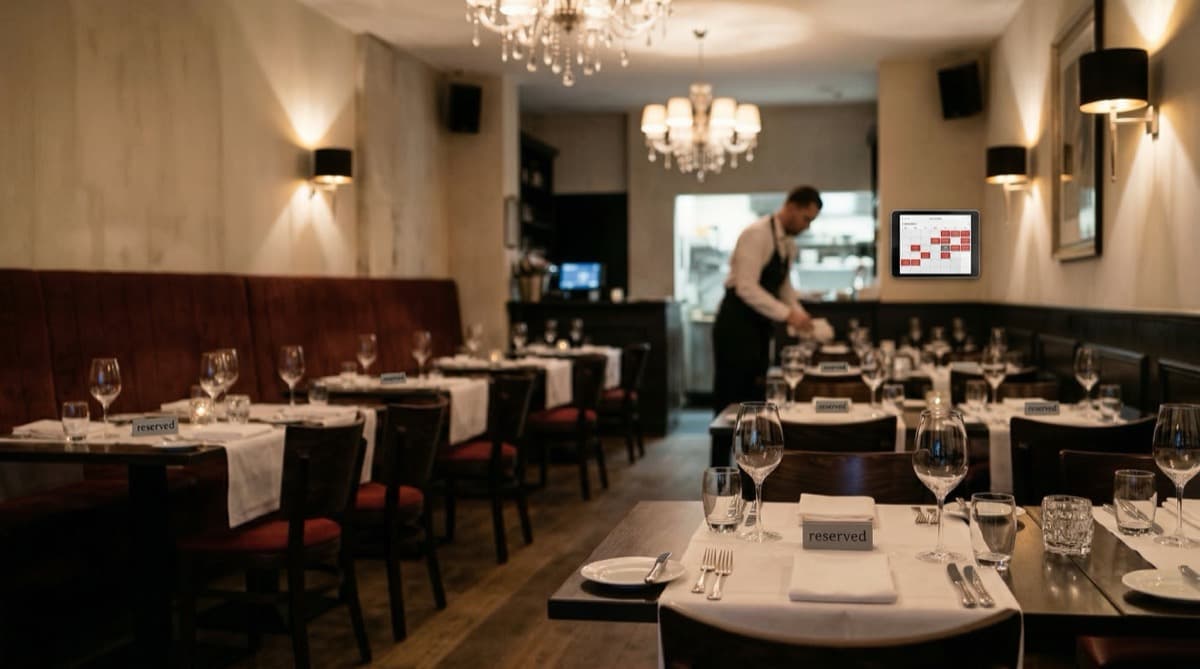
Every week, tables in Dutch starred restaurants sit empty that were actually reserved. No-shows cost the sector millions per year. But increasingly smart solutions are emerging — from waiting lists and deposits to real-time availability.
The no-show: an expensive empty chair
No-shows — guests who make a reservation but don't turn up without any notice — are one of the most persistent problems in the hospitality industry. In fine dining, where dinner for two can easily exceed two hundred euros, every empty table directly affects a restaurant's viability.
Industry figures show that the no-show rate in the Netherlands averages around 5 to 10%, with peaks on public holidays and weekends. At a restaurant with forty covers, that means three to four tables remaining empty on a busy evening — while there's a waiting list of people who would have loved to come.
An empty table at a Michelin-starred restaurant is not a neutral event. The ingredients have already been purchased, the staff is ready, the mise en place has been prepared. Costs continue, but revenue doesn't materialise.
The other side: the guest who can't get in
At the same time, there is frustration on the other side. The guest who genuinely wants to go out for dinner but keeps drawing a blank. Waiting lists at one restaurant, no availability at another. Not because there really is no space, but because the availability is hidden behind a patchwork of reservation systems.
That frustration is compounded by the lack of a central overview. Those who are willing to be flexible — a different restaurant, a slightly different time, a different city — can in theory almost always find something. But gathering that information together is a time-consuming task. Many people give up before they've checked all the options.
Why don't people cancel?
The reasons for no-shows are diverse, but a few patterns keep recurring. Some guests make reservations at multiple restaurants simultaneously and only decide at the last moment. Others simply forget they have a reservation. A third group finds it uncomfortable to call and cancel, especially when the reason is trivial.
What stands out is that the threshold for making a reservation has become much lower thanks to online booking systems. Two clicks and you have a table. But that same low barrier also makes it easier to treat a reservation as non-binding. The psychological distance from the consequence — a restaurant sitting with empty seats — is great.
What restaurants are doing about it
The hospitality industry responds with a range of measures. Confirmation emails and SMS reminders have become standard. More and more restaurants ask for a credit card at the time of booking, with a cancellation policy of 24 to 48 hours in advance. Some top restaurants even work with advance payment or non-refundable deposits, comparable to buying a theatre ticket.
The effect is measurable: restaurants that require a deposit report no-show rates dropping below 2%. But there is a downside. A deposit raises the barrier to making a reservation, and not every guest experiences this as hospitable. It's a trade-off between protection and accessibility.
Other restaurants opt for deliberate overbooking — similar to how airlines do it. They accept more reservations than they have tables, expecting that some guests won't show up. A risky strategy that leads to full houses on a good evening, but to frustrated guests being turned away on a poor estimate.
The paradox of full and empty
This is where the paradox arises. On one hand, restaurants are afraid of empty tables due to no-shows and take measures that make booking more restrictive. On the other hand, there is a large group of potential guests who would love to come but can't find a spot — precisely because availability is inaccessible.
Those two groups don't know of each other's existence. The restaurant only sees the no-show and the waiting list. The searching guest only sees 'no availability'. There is no mechanism that translates a last-minute cancellation from one into an invitation to the other.
Some platforms are experimenting with this. Formitable, for example, offers a waiting list function where guests automatically receive a message when a table becomes available. But that only works within that one platform — not across systems.
What could be better?
The core of the problem is information asymmetry. Restaurants don't know who is currently looking for a table. Guests don't know where a table has just become available. Bringing those two streams together — current availability and current demand — is precisely what's missing.
For guests this means: the easier it becomes to quickly see where there's still space, the less reason there is to reserve at three restaurants simultaneously 'just to be safe'. More transparency in availability can thus indirectly reduce the no-show problem.
And for restaurants: the more visible your remaining capacity is, the greater the chance that an empty table will still be filled by someone who genuinely shows up. Not via an extra commission channel, but simply because the guest was able to find you.
Wondering where you can still get a table tonight?
Find available restaurantsRelated articles

Reservation systems in the Netherlands: a fragmented landscape
February 19, 2026 · 6 min read

Digital reservations in Europe: why the Netherlands is so far ahead
March 12, 2026 · 9 min read

Data quality and the European reservation landscape: what you measure determines what you see
March 15, 2026 · 10 min read